India's national security strategy needs to be revised periodically since the global and regional geopolitical situation is dynamic, points out Commodore Venugopal Menon (retd).

Defence Secretary Lloyd Austin on Thursday directed that the aircraft carrier USS Ronald Reagan and the ships in her strike group will remain on station in the general area to monitor the situation.

'The supreme art of war is to subdue the enemy without fighting.' Former RA&W official Jayadeva Ranade explains what China's military reforms mean for the world.

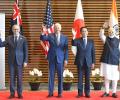
In his opening remarks at a ministerial meeting in Tokyo of the Quadrilateral coalition, also known as 'Quad', External Affairs Minister S Jaishankar said India remained committed to a rules-based world order, respect for territorial integrity and sovereignty, and peaceful resolution of disputes.
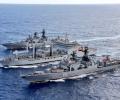
'The Indian Navy has sufficient combat power in areas of interest to India that can quickly scale up operations if the need arises.' 'This includes all the choke points leading into the Indian Ocean as also areas within.'

INS Vishakapatnam's ground attack and anti-ship capabilities are achieved through a bank of BrahMos cruise missiles that can be fired at targets up to 295 km away.
India has the ability in all respects to be a great power and address our security challenges in the best national interests, says Commodore Venugopal Menon (retd).

Prime Minister Narendra Modi along with his counterparts from Australia and Japan on Friday attended the first in-person meeting of Quad leaders hosted by US President Joe Biden during which they plan to discuss issues like climate change, Covid-19 pandemic and challenges in the Indo Pacific, amidst China's growing military presence in the strategic region.

The agreement would divert China's attention and keep them busy in the Pacific theatre, probably resulting in a reduction in threat perception in our area of interest in the Indian Ocean, notes Commodore Venugopal Menon (retd).

Colombo seems to be veering to the middle path between China and the US on global matters, but in regional matters of strategic security, it is increasingly identifying with India, points out N Sathiya Moorthy.
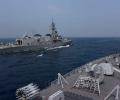
The navies of India, the US, Japan and Australia on Tuesday held a series of complex manoeuvres in the Bay of Bengal, kick-starting the four-day-long first phase of the Malabar naval exercise, seen as a prelude to future military cooperation among the member nations of the Quad or Quadrilateral Coalition.

China, which has territorial disputes with many countries in the strategic Indo-Pacific region, has been opposing the Quad alliance since its formation.
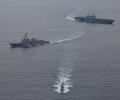
The second phase of the mega exercise is scheduled to be held from November 17 to 20 in the Arabian sea.

Admiral Philips Davidson, Commander of the US Indo-Pacific Command, also told the powerful Senate Armed Services Committee on Tuesday that China's recent activities along the Line of Actual Control have opened India's eyes to what cooperative effort with others might mean for their own defensive needs as he observed that New Delhi, in the very near term, will deepen its engagement with the Quad.

India's decision to heed to Australia's request to be part of the mega naval drill comes in the midst of growing strain in ties with China over the border row in eastern Ladakh.

The attack did not result in any human losses, it said, adding that the remnants of the intercepted and destroyed ballistic missiles fell in separate areas around Abu Dhabi.
'Our strategy should be to 'hold the line' in the north on the Sino-Indian land frontier, but maintain and, if possible, enlarge India's current edge in the maritime south.'

The exercise is taking place at a time India and China are locked in a nearly six-month-long bitter border standoff in eastern Ladakh that has significantly strained their ties.

This is the fourth of the six submarines the Indian Navy is to induct under the Kalvari-class submarine Project-75.
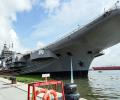
In New Delhi's corridors of power, debate continues on whether the navy even needs a third aircraft carrier.

'When I crossed that point where I had the accident, I felt light and that was a very physical experience. I felt something leave me.' Shyam G Menon chronicles the voyages of that incredible Indian sailor, Abhilash Tomy.
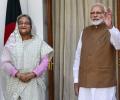
'If the Bangladesh-China relationship strengthens further, it can only be to India's detriment,' notes Vice Admiral Premvir Das.
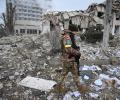
Reconstruction efforts after the Russia-Ukraine war will be dominated by the heft of the membership of major nations across international organisations. India is hamstrung because it does not play host to any major global institution nor does it hold positions of significant influence in the ones in which it has membership. As a result, the world's sixth largest economy is obliged to follow the rules set by most of them.
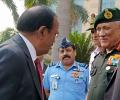
Gen Bipin Rawat's appointment, first as army chief superseding two other army commanders, and then as CDS, was the consequence of his close personal rapport with National Security Advisor Ajit Doval. Now, with General Rawat gone and nobody named to replace him as CDS, it is evident that no other top military officer enjoys that relationship with Doval, observes Ajai Shukla.

Britain has finalised 1 billion pounds worth of new trade and investment with India, creating over 6,500 jobs in the UK, to be signed off at a virtual summit between Prime Minister Boris Johnson and his Indian counterpart Narendra Modi on Tuesday. The investments confirmed by Downing Street on Monday evening form part of an Enhanced Trade Partnership (ETP), which will set the ambition to double the value of UK-India trade by 2030 and declare a shared intent to begin work towards a comprehensive Free Trade Agreement (FTA). "Like every aspect of the UK-India relationship, the economic links between our countries make our people stronger and safer," Johnson said.

'Good to meet US Secretary of State @SecBlinken today. I welcome President Biden's strong commitment to strengthen the India-US Strategic Partnership, which is anchored in our shared democratic values and is a force for global good,' Modi tweeted.
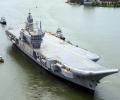
The MiG29K and MiG29KUB, the aircraft carrier's primary fighters, spent more time in the hangar than in the air, with fleet serviceability remaining below 50 per cent, reports Ajai Shukla.

He said that "the state of the border will determine the state of the relationship, that's natural".

US Vice President Kamala Harris would host a separate meeting with the prime ministers of three Quad countries -- India, Australia and Japan -- at the White House to discuss with them the important factors for democracies to go forward, officials said.

The navy said the missile hit the target at maximum range with precise accuracy.

The Americans have expended a lot of diplomatic energy to coax India into toeing their line but India has refused to buckle under pressure. As Foreign Minister Subrahmanyam Jaishankar said, India has not taken anyone's side but its own side, points out Virendra Kapoor.

The Global Hawk can carry out surveillance of a stretch of land or ocean for over 30 hours continuously, physically scanning up to 100,000 sq km each day.
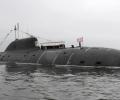
Admiral describes it as 'a path-breaking change'; defence ministry official disagrees.
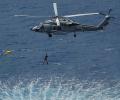
India, Japan and the Unoted States on Friday kicked off their marine war games, Malabar Exercise, close to the South China Sea as they focus on deeper military ties and greater interoperability amid rising tensions in the region.

Modi will arrive in France on Thursday evening and straightaway head for talks with Macron, who will also host a working dinner for the visiting leader.

Four frontline warships of the Indian Navy participated in the 'PASSEX' exercise when the US carrier strike group was transiting through the Indian Ocean Region on its way from the South China Sea, the officials said.

'There will be much for President Trump and Prime Minister Modi to discuss including growing Chinese military cooperation with Pakistan, which heralds a new attempt by China and Pakistan to neutralise India's influence in its Indian Ocean neighbourhood,' notes Ambassador G Parthasarathy.

As a percentage of the military budget, the navy's share has fallen from 19 per cent in 2010-2011 to just 15.5 per cent this year. With the Indian Navy's annual budget declining steadily, security planners are reluctant to green light crucial projects, discovers Ajai Shukla.

In a few years from now, India will be looking at an entirely different type of military adversary across the borders, in our waters, in the air, in space and in our communication networks, says Nitin Pai.

The latest avatar of the F-15 is designed to deal with the world's most potent air threats that are emerging from China.
